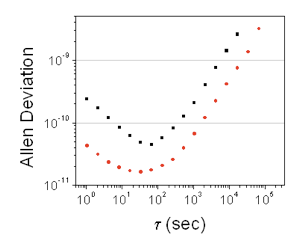





The first 87Rb-based CSAC physics package has been demonstrated in a volume of 12 mm3, dissipating 195 mW of power at an ambient temperature of 22 °C. Excited using light resonant with the D1 line, it exhibited a much better short-term stability than CSACs operating on the D2 line of cesium.
A fractional frequency instability of 4 ×10-11 / τ1/2 was achieved for integration times between 1 s and 10 s. Using noble gases of neon or argon, a residual long-term drift of -5 ×10⁻⁹ / day was measured. When using the D1 line, optical Zeeman pumping and the existence of a dark trapping state cause atoms to accumulate in the “stretched state”. As a result of this a higher cell temperature is required, which increases the power consumption of the CSAC as well as the broadening due to spin-exchange collisions.
References:
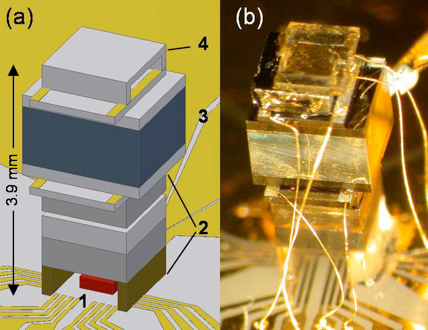
The chip-scale atomic clock based on 87Rb. (a) Schematic of the clock. The components are: 1–the VCSEL, 2–the optics package including (from bottom to top) a glass spacer, a neutral-density filter, a refractive microlens surrounded by an SU-8 spacer, a quartz λ/4 waveplate, and a neutral-density filter, 3–the 87Rb vapor cell with transparent ITO heaters above and below it, and 4–the photodiode assembly. (b) Photograph of the clock physics package.
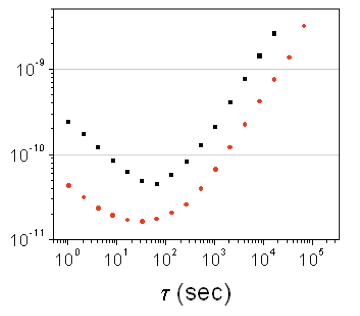
Measured Allan deviation for the 87Rb D1 CSAC (red dots). A clear improvement in stability is evident over the first CSAC, which was based on the Cs D2 line (black squares).