




The performance of an atomic clock or magnetometer based on CPT is determined by the resonance width and the signal-to-noise ratio. In particular, a large signal amplitude results in a high stability for a clock or a high sensitivity for a magnetometer. The signal amplitude is typically evaluated by the "contrast," either as an "absorption contrast" (which we define as the ratio of the change in light absorption on resonance to the absorption off resonance) or as a "transmission contrast," (which we define as the ratio of the change in light transmission on resonance to the transmission off resonance). In many initial experiments investigating CPT resonances, the resonance contrast was very small: typically the light absorption changed by only about 1 % when the resonance was excited. Since in principal an absorption contrast approaching 100 % is possible, it is of value to investigate ways to increase the absorption contrast and thereby improve the stability of CPT atomic clocks.
Initial work at NIST in this area focused on differences between wavelengths of the excitation laser. It was established that light resonant with the D1 optical transition in Rb-87 at 795 nm generated resonances of higher contrast than did light resonant with the D2 transition at 780 nm. This is due to simpler excited-state hyperfine structure on the D1 line and more symmetrical transition probabilities and is expected to result in atomic frequency references with better short-term frequency stability. A comparison of CPT resonances excited using light resonant with D1 and D2 lines is shown in the figure below.
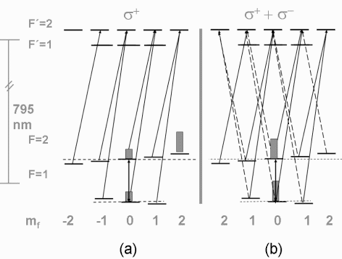
One difficulty with the excitation of CPT resonances with circularly polarized light resonant with the D1 transition is that optical pumping occurs, increasing the population in the Zeeman level with maximal (or minimal) azimuthal quantum number (mF = ±F). An atomic level diagram illustrating this effect is shown in the figure (a) below. Atoms in this "trap" state do not contribute to the CPT resonance, nor do they contribute to the background absorption. However, they do collide with atoms in the mF = 0 levels and cause broadening of the CPT transition. In addition, if a large fraction of the atoms accumulate in this trap state, a higher cell temperature may be necessary to achieve the same absorption, and therefore the same CPT signal strength.
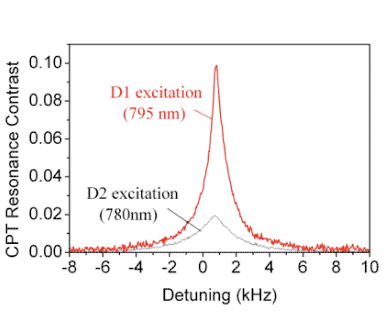
Comparison of CPT resonances excited in a vapor of Rb-85, using light resonant with the D1 transition and D2 transition. The larger resonance corresponds to improved clock frequency stability.
Several approaches can be taken to address this difficulty. One of these is illustrated in figure (b) above. In this approach, a second circularly polarized laser beam is applied to the atoms, with a polarization orthogonal to the first. If this second light field is identical to the first except for the polarization, the total light field is linearly polarized. In this case, although the population in the mF = 0 levels increases since the trap state is no longer present, the CPT transition probability between the two mF = 0 levels is zero due to the symmetry of the atomic matrix elements and no resonance is observed.
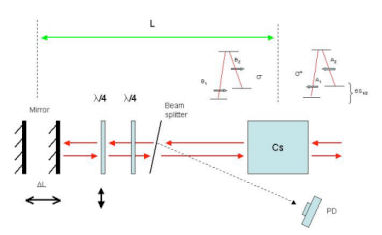
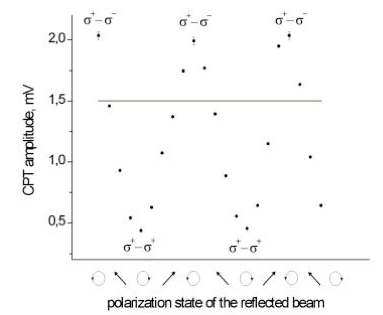
One way to address this problem is to arrange the two laser beams so that they are counter-propagating and delay one field with respect to the other by one-half of one microwave wavelength. In this configuration, the symmetry of the atomic matrix elements is such that the CPT transition amplitudes for each of the fields add coherently and generate a large CPT resonance amplitude. An experiment to test this was carried out and the results are shown below. The figure on the left shows the experimental arrangement while the figure at right shows the enhancement of the CPT amplitude that can be obtained in this retro-reflecting configuration.
(a) Optical pumping into the F = 2, mF = 2 state by circularly polarized light on the D1 transition in Rb-87. Population in this state does not participate in the CPT resonance but does cause spin-exchange broadening of the resonance, leading to degraded stability. (b) The use of two orthogonal circular polarizations to eliminate the "trap" state and increase the population in the mF = 0 levels.
Enhancement of the CPT resonance amplitude obtained through the use of a retro-reflected laser beam. An enhancement is only observed when the two circular polarizations are orthogonal.