





The performance of microfabricated atomic clocks is characterized in a number of ways. In addition to the frequency stability, which is commonly viewed as the primary figure of merit for many clocks, size, power dissipation and ease of assembly are also important. As might be expected, many trade-offs exist: smaller, lower-power clocks, for example, are also usually less stable that their larger, more power-hungry counterparts. As a result, the frequency stability of any clock must be considered in light of its other characteristics and the applications for which it is designed.
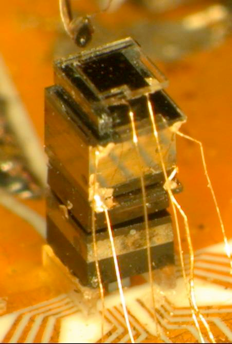
The physics package constructed at NIST stands 4.2 mm above the baseplate on which it is mounted and measures 1.5 mm on a side for a total volume of 9.5 mm3, which is about the size of a grain of rice. The interior of the cell has a volume of 0.81 mm3; just under 10 % of the volume of the physics package is therefore used to confine the atoms. The baseplate on which the laser is also directly mounted was heated to a temperature of 46 °C to tune the laser wavelength to the atomic optical transition used to excite the atoms. The cell was heated with the ITO heaters to a temperature of 80 °C so that the atomic vapor had enough atoms in it to substantially absorb the light field. It has been found previously that an optical absorption near 50 % optimizes the performance of the device. The electrical power required to heat the cell was only 70 mW, suggesting that with some future improvements in design, the device could be operated with a battery of modest size.
The frequency stability of atomic clocks is usually characterized by the Allan Deviation, σy(τ), which measures the fractional frequency uncertainty of the clock output frequency when it is averaged for a time t. Over short periods (t less than ten seconds, say), the Allan deviation is typically determined by two factors: the frequency width of the clock resonance and the signal-to-noise ratio with which the center of the resonance can be measured.
We have characterized the frequency instability of several microfabricated atomic frequency references. The first microfabricated devices constructed in our laboratory were based on cesium atoms. The CPT resonance was excited with optical fields tuned to the D2 transition in Cs at 852 nm. For the clock shown in Figure 1, which had a cell volume of 0.81 mm2 and a buffer-gas pressure of 25 kPa of Ar/N2, a CPT resonance was observed as in Figure 2, with a width of 7.1 kHz and a contrast (change in absorption due to the CPT divided by the total absorption) of 0.91 %.
By modulating the frequency of the local oscillator, and using lock-in detection, an error signal is generated, which is fed back to correct the LO frequency. This stabilized frequency is monitored as a function of time by mixing it with a 4.600 GHz signal from a dielectric-resonator oscillator locked to a hydrogen maser. The intermediate frequency, at about 3.6 MHz, is counted with a frequency counter, which is also locked to the hydrogen maser. Data are collected with a computer and stored as a time series. From this time series, the Allan deviation can be estimated. The frequency-time series is shown in the figure below at left. A short-term instability of 2.4×10⁻¹⁰/√τ is obtained.
Improvements in the chips-scale atomic clock stability can be obtained through excitation on the D1 line rather than on the D2 line. We have demonstrated a chip-scale clock based on 87Rb that achieves a short-term stability near 4×10-11/√τ.
The long-term instability of the frequency reference is determined primarily by a substantial linear drift of the fractional frequency of roughly -2×10⁻⁸/day. The drift and corresponding Allan deviation at long integration times are shown below. The origin of this drift is currently not well understood, but we speculate that it is related to chemical processes within the cell that affect the pressure of the N2 buffer gas. One possible process that could explain the observed drift is absorption of N2 by residual Ba remaining in the cell after the chemical reaction that produces the cesium. If this is the case, the drift could be eliminated by fabricating the cells using a process that does not involve barium, for example by use of an atomic beam. Residual long-term fluctuations in the output frequency of the microfabricated atomic clock are thought to be related to changes in the ambient temperature.
The problem with the drift has been addressed through the development of a new cell fabrication technique, which allows alkali metal to be deposited in the cell without the presence of Ba. Atom vapor cells with improved long-term stability are important in that they demonstrate that alkali cells fabricated using MEMS are compatible with the long-term stability needs of atomic frequency references.
Additional information:
For more information on the Allan deviation, see http://www.boulder.nist.gov/timefreq/phase/Properties/main.htm or
References:
Physical characteristics
Short-term frequency stability

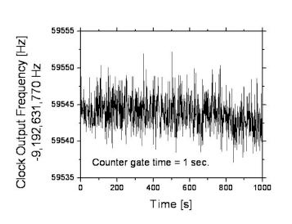
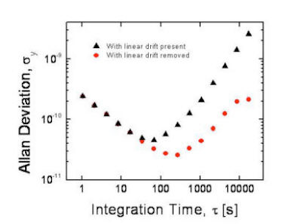
Time series and Allan deviation for the cesium microfabricated atomic clock.
CPT resonance measured in the cesium microfabricated atomic clock.
LONG-term frequency stability
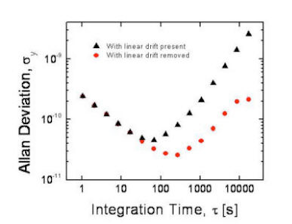
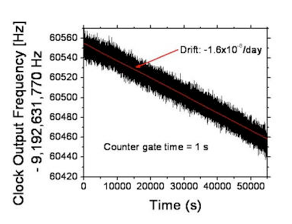
Long-term drift observed in a chip-scale atomic clock. This drift is probably caused by absorption of the N2 buffer gas by residual barium left in the cell after creation of the cesium.