





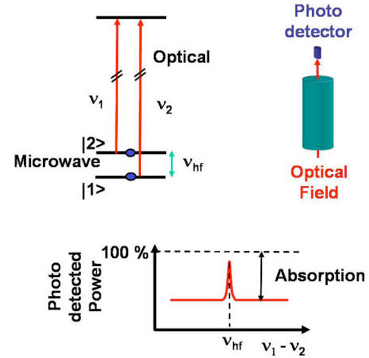
Coherent population trapping (CPT) is a nonlinear phenomenon in atoms in which coherences (electromagnetic multipole moments) between atomic energy levels are excited by pairs of optical fields. In one of the simplest examples, a coherence between two components of the atom's hyperfine-split ground state is generated through the simultaneous coupling of both levels to a common excited state with the optical fields. When the difference of the frequencies of the optical fields is near the atomic hyperfine splitting frequency (ν2 - ν1 ≈ νhf) it can be shown that atoms in one specific superposition of the two ground-state sub-levels, |NC> = A|1> + B|2>, do not interact with the optical field at all. This superposition state is commonly referred to as a "dark state" or "CPT state". Atoms in the orthogonal superposition, |C> = B|1> - A|2>, interact strongly with the optical field. Therefore, if an atom starts off in some arbitrary state, |S> it will absorb photons at a rate proportional to the square of the matrix element <S|C>. Through the optical pumping process, atoms accumulate in the dark state |NC> and stop absorbing photons from the light field, and the absorption of the atomic sample decreases. A resonance therefore occurs: when ν2 - ν1 is far from νhf, then the absorption is large, and when ν2 - ν1 is close to νhf, the absorption is reduced. The CPT resonance effect is shown conceptually in the figure above.
The CPT resonance is characterized by its width, Dn, and its height, h, often stated in terms of the absorption contrast, C=h/absorption. These two parameters determine how effectively the resonance can be used to define a specific frequency for a clock. Narrow, high-contrast resonances imply good frequency stability. Substantial NIST research has investigated how to optimize CPT resonances for use in atomic frequency references. Some of these results are presented in the references below.
Contact: Svenja Knappe
Coherent population excitation of an atomic resonance using a frequency-modulated semiconductor laser.