|
|
|
| Opto-electronic oscillator | |
|
|
|
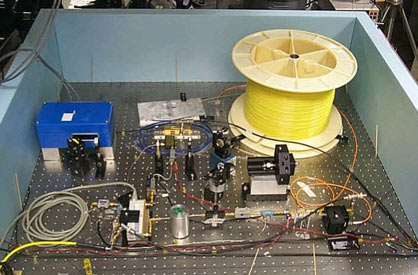
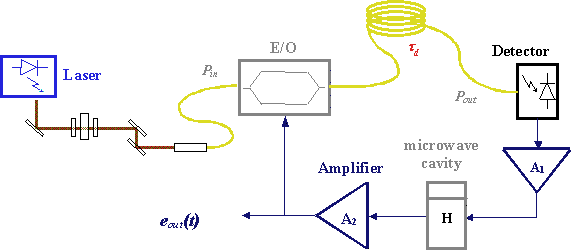
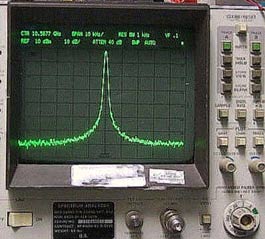
The opto-electronic oscillator (OEO) is a low-noise microwave oscillator which uses an optical fiber to create a long delay line with extremely low loss. The basic scheme is shown in the figure below. A RF signal is encoded as amplitude modulation on an optical field using a Mach-Zehnder electro-optic modulator (E/O). The light, which originates from a 1.3 mm diode laser, is sent through a long (~1 km) optical fiber and is detected in a fast photodiode. The RF signal from the photodiode is then amplified, filtered and sent back into the E/O. With enough RF gain, self-oscillation occurs at the frequency transmitted by the RF filter in the feedback loop (~10 GHz in this case). The long delay line with low loss has the potential to enable the output microwave signal to have extremely low phase noise. The primary application goal for this particular oscillator is use as a local oscillator for new generations of primary frequency standards being developed at NIST and elsewhere.
The scheme
The microwave signal
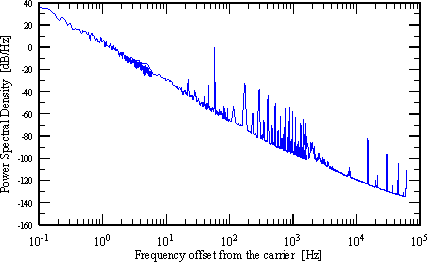
Power spectral density of phase fluctuations
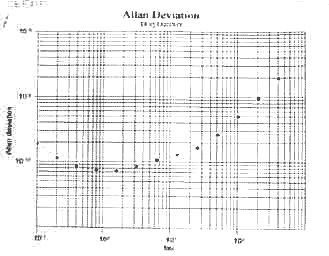
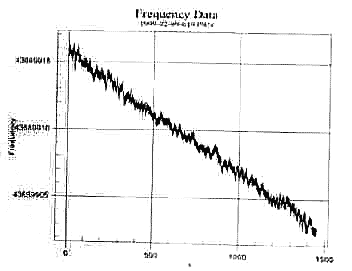
Stability
John Kitching, NIST, [email protected]
